
Five Nights at Freddy’s 4
Related Games





Description
🔥 What is Five Nights at Freddy’s 4 for PC
Five Nights at Freddy’s 4 is the fourth main installment in Scott Cawthon’s legendary horror series, and it represents a dramatic shift in both setting and tone. Released in 2015, the game abandons the security office of the earlier entries and instead takes place within the nightmarish confines of a child’s bedroom. Rather than relying on security cameras and door buttons, the player must listen carefully for subtle audio cues while checking doors, closets, and beds for terrifying animatronic monsters.
Set in a distorted suburban home that feels both familiar and surreal, the game delves deeply into the psychological horror of childhood fears. It’s less about mechanical management and more about pure tension, paranoia, and the dread that comes from not knowing whether the thing breathing in the dark is real or imagined. By placing the player in the role of a terrified child instead of an adult guard, Cawthon transforms the formula into something intimate, haunting, and uncomfortably personal.
The story, told through cryptic mini-games and environmental clues, reveals fragments of a tragic backstory connected to the overarching Freddy’s lore. The events of this entry are both a continuation and a reimagining, bridging the past and future of the series while grounding everything in the raw vulnerability of childhood trauma. It’s not just a haunted-house simulator it’s a descent into memory, guilt, and fear itself.
👉 Features of Five Nights at Freddy’s 4
Psychological Focus on Fear and Sound
Unlike previous games where visual cues dominated, Five Nights at Freddy’s 4 builds its entire gameplay around audio perception. Every small creak, breath, or footstep could mean survival or death, forcing the player to rely on headphones and sharpened attention. This shift in design makes the experience far more immersive and personal, as you’re not watching horror from behind a screen you are living it, moment to moment, with your heart racing at every whisper.
The sound design, from muffled laughter in distant halls to mechanical scraping, constructs an atmosphere so thick it almost feels tactile. Every decision, such as whether to flash a light or close a door, depends on those fragile auditory signals. It’s horror distilled into pure tension and reaction.
Minimalist Interface and Maximum Immersion
Five Nights at Freddy’s 4 strips away all the UI clutter and mechanical barriers that separated players from the threat in earlier entries. There are no cameras to flip through, no energy bars to monitor, and no safety nets to rely on. You must move physically around the room, listen, check, and hope.
This minimalist approach amplifies the feeling of helplessness. You are not a detached operator you’re a scared child clutching a flashlight, counting the seconds until morning. The simplicity of control hides a complex psychological trick: by removing visible systems, the player’s mind fills the void with dread, imagining threats in the silence.
Deep Lore and Symbolism
Every detail in Five Nights at Freddy’s 4 carries emotional or narrative significance, whether it’s the child’s toys, the distorted versions of animatronics, or the dreamlike mini-games that punctuate the nights. These moments tell fragments of a larger story about trauma, family, and the blurred boundary between dreams and reality.
Cawthon never delivers exposition directly. Instead, players piece together meaning from subtle hints a crying child, a locked door, a party gone wrong. This cryptic method of storytelling creates one of the most debated and analyzed narratives in modern horror gaming, inspiring countless theories and interpretations.
Nightmare Animatronics
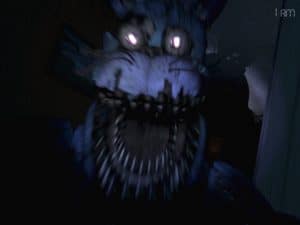
The animatronics in this entry are not the broken-down robots of the restaurant; they are exaggerated monstrosities, decaying and animalistic, designed to embody fear itself. Nightmare Freddy, Bonnie, Chica, Foxy, and Fredbear appear like grotesque hallucinations sharpened teeth, glowing eyes, and torn metal lurking in the dark.
Their designs reflect the game’s psychological shift. These are not enemies to outsmart with tools they are symbols of the child’s terror, amplified and unrelenting. The jump scares feel more personal and violent than ever before, heightened by the intimacy of the bedroom setting.
Gameplay
Survival in Complete Darkness
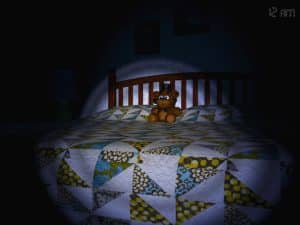
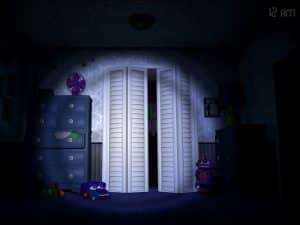
At its core, Five Nights at Freddy’s 4 is about surviving five nights (plus hidden extras) by monitoring three key locations: two hallway doors, a closet, and the bed behind you. The player must move between these points and react based on auditory cues if breathing is heard, the door must remain closed; if not, a flashlight can safely check the area.
This system rewards patience and precision rather than speed or reflexes. Every mistake is costly, and every correct decision feels like a victory wrestled from fear. The absence of visual confirmation until the final second creates unbearable suspense that defines the entire experience.
Progressive Difficulty and Unforgiving Challenge
Each night introduces new patterns and increased aggressiveness from the animatronics. By the fourth night, you are juggling multiple threats, each requiring slightly different timing and response. The margin for error is minimal, and success depends on learning the exact rhythm of the sounds around you.
The tension escalates so naturally that by the final night, every movement feels like a calculated risk. The game also includes hidden levels and an infamous Nightmare mode, where the creatures move faster and the player’s reaction window narrows to a fraction of a second.
Mini-Games and Story Integration
Between the terrifying nights, players experience pixel-art mini-games that slowly reveal the story of the crying child, his family, and the origins of his nightmares. These sequences contrast sharply with the realistic terror of the gameplay, yet they deepen the emotional impact.
They depict moments of bullying, loss, and fear, gradually building toward a tragic climax that ties into the broader Five Nights lore. These interludes serve as both relief and revelation, allowing the player to catch their breath while pondering the meaning of what they’ve seen.
Graphics
Distorted Domestic Horror
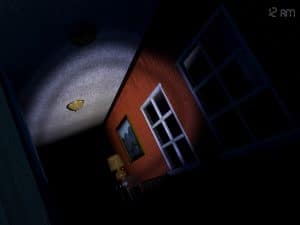
Visually, Five Nights at Freddy’s 4 is striking because of its simplicity. The child’s bedroom, with its familiar furniture and toys, becomes an arena of terror through masterful use of lighting and perspective. The flashlight beam cuts through darkness like a knife, illuminating only what you absolutely need to see.
This claustrophobic framing transforms ordinary objects a dresser, a door, a bed into potential threats. The sense of scale is also crucial: as a small child, the player’s viewpoint exaggerates the room’s size and darkness, making it feel endless and oppressive.
Nightmare Design and Lighting Effects
The animatronics are rendered with grotesque detail, combining organic textures with sharp metallic elements. Their mouths are filled with layers of jagged teeth, their bodies twitch unnaturally, and their glowing eyes pierce the darkness like animal predators.
Lighting plays a crucial narrative role. The brief flash of a flashlight can expose the monster in horrifying clarity, while too much hesitation leaves you staring into a black void where you can only imagine what waits. This use of light and shadow creates a rhythm that mimics the player’s heartbeat fast, uneven, and full of dread.
Sound as a Visual Substitute
Since much of the screen is intentionally obscured, sound becomes the visual substitute that paints the world around you. The ambient hum, floor creaks, and distant laughter serve as invisible scenery, allowing players to see through hearing.
This sensory balance between light and sound makes the experience uniquely immersive. The player doesn’t just observe horror they anticipate it, constructing it mentally from fragments, which is far more terrifying than any fully lit image.
Pros and Cons
✔️ Pros
- Deeply immersive sound design that redefines how tension is built in horror games
- Unique psychological focus on childhood fear and vulnerability
- Visually striking animatronic designs that blend mechanical and organic horror
- Minimalist interface that enhances immersion and removes distractions
- Storytelling through environmental clues and haunting mini-games that reward analysis
❌ Cons
- Extremely punishing difficulty that may frustrate casual players
- Heavy reliance on sound may alienate players without high-quality audio setups
- Minimal interactivity outside of the central gameplay loop
- Cryptic storytelling can confuse those unfamiliar with the series’ lore
ℹ️ Game information


⭐ Installation Instructions
- The game is fully complete, you just need to install it, so there is no need to unpack it or download it from other sources.
- Just run the Five Nights at Freddy’s 4.exe installation file.
- Simply launch the game from shortcut desktop.
⚙️ System Requirements
✅ Minimum:
- OS: Windows XP/Vista/7
- Processor: 2 GHz Intel Pentium 4 / AMD Athlon
- Memory: 2 GB RAM
- Graphics: NVIDIA GeForce GT 210
- DirectX: Version 9.0
- Network: Broadband Internet connection
- Storage: 1 GB available space
Images
Video
Best Rated Games
 Virtua Cop 21.88.0 SEGA
- UpdatedThe Sims 41.122.218.1030 Maxis
- Grand Theft Auto V1.0.3751.0/1.72 Rockstar North
- Hogwarts LegacyBuild 1420267 Avalanche Software
- Minecraft Dungeons1.17.0.0 Mojang Studios
- Microsoft Flight Simulator 20241.5.27.0 Asobo Studio
- EA Sports UFC 51.29 Electronic Arts
- Need for Speed: Payback1.0.51 Ghost Games


